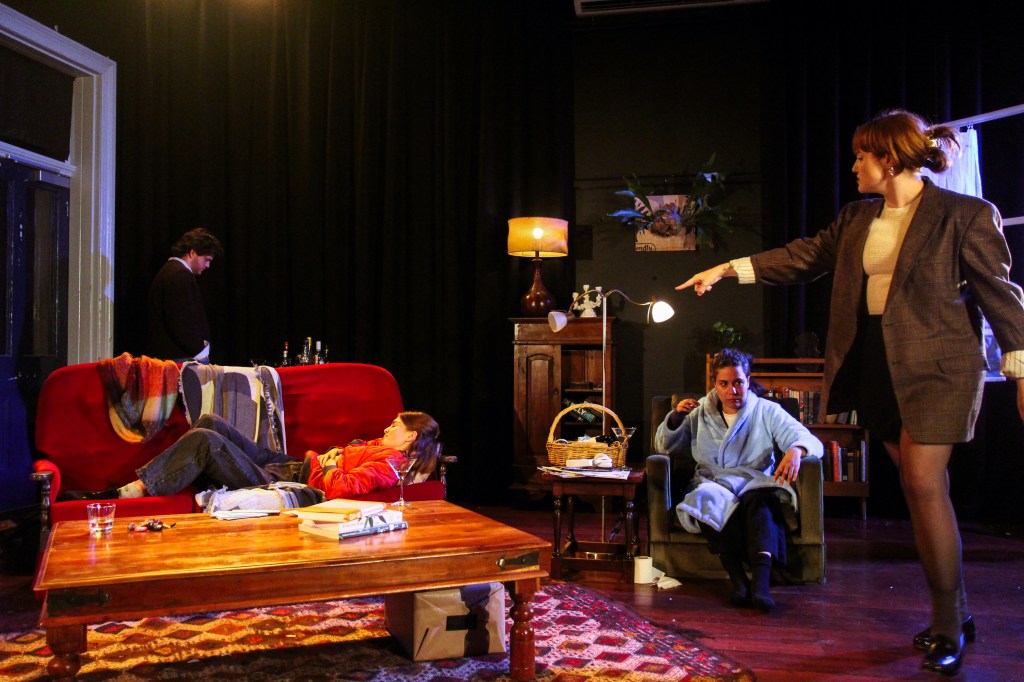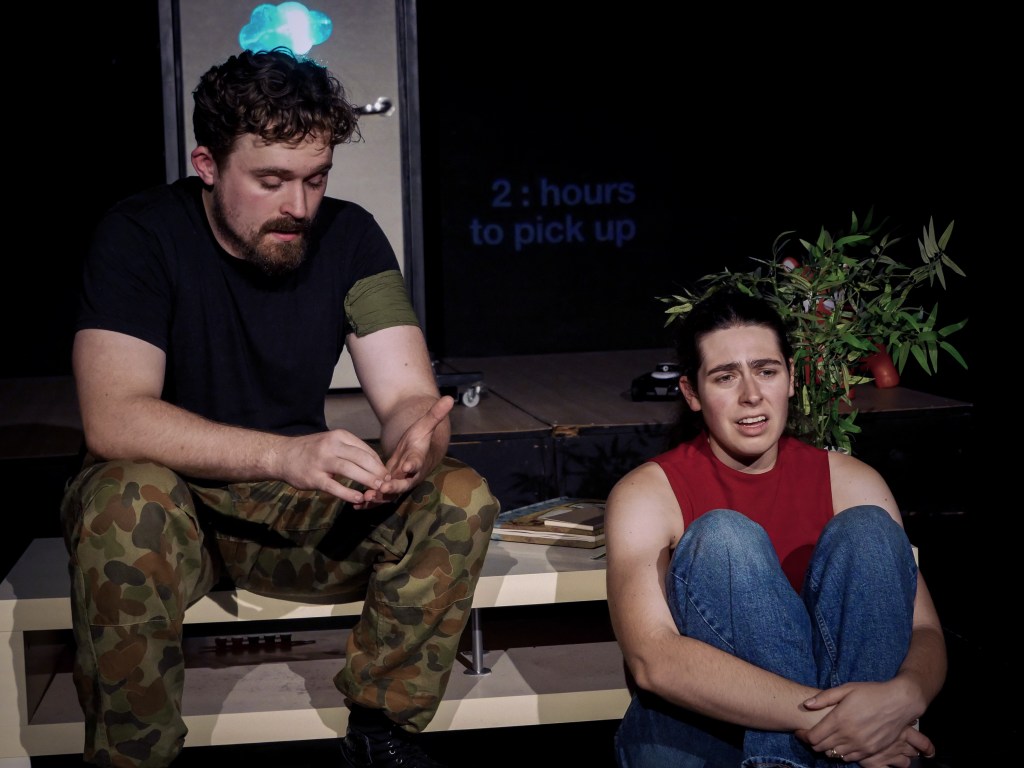
There is an ancient Chinese curse that goes, “May you live in interesting times” – a curse that feels apt as we watch the Trump presidency’s tawdry, postmodern, television soap opera adaptation of the fall of the Roman Republic. Still, for the characters in the play ARYAN by Amanda Crewes, the curse is all too real as it threatens a hypothetical nation in the near future with a cull of disabled children. ARYAN focuses on the plight of a white middle-class couple, Lola (Ava Lyas) and Derrick (Adam Leeuwenhart), whose child is disabled and scheduled to die in 24 hours.
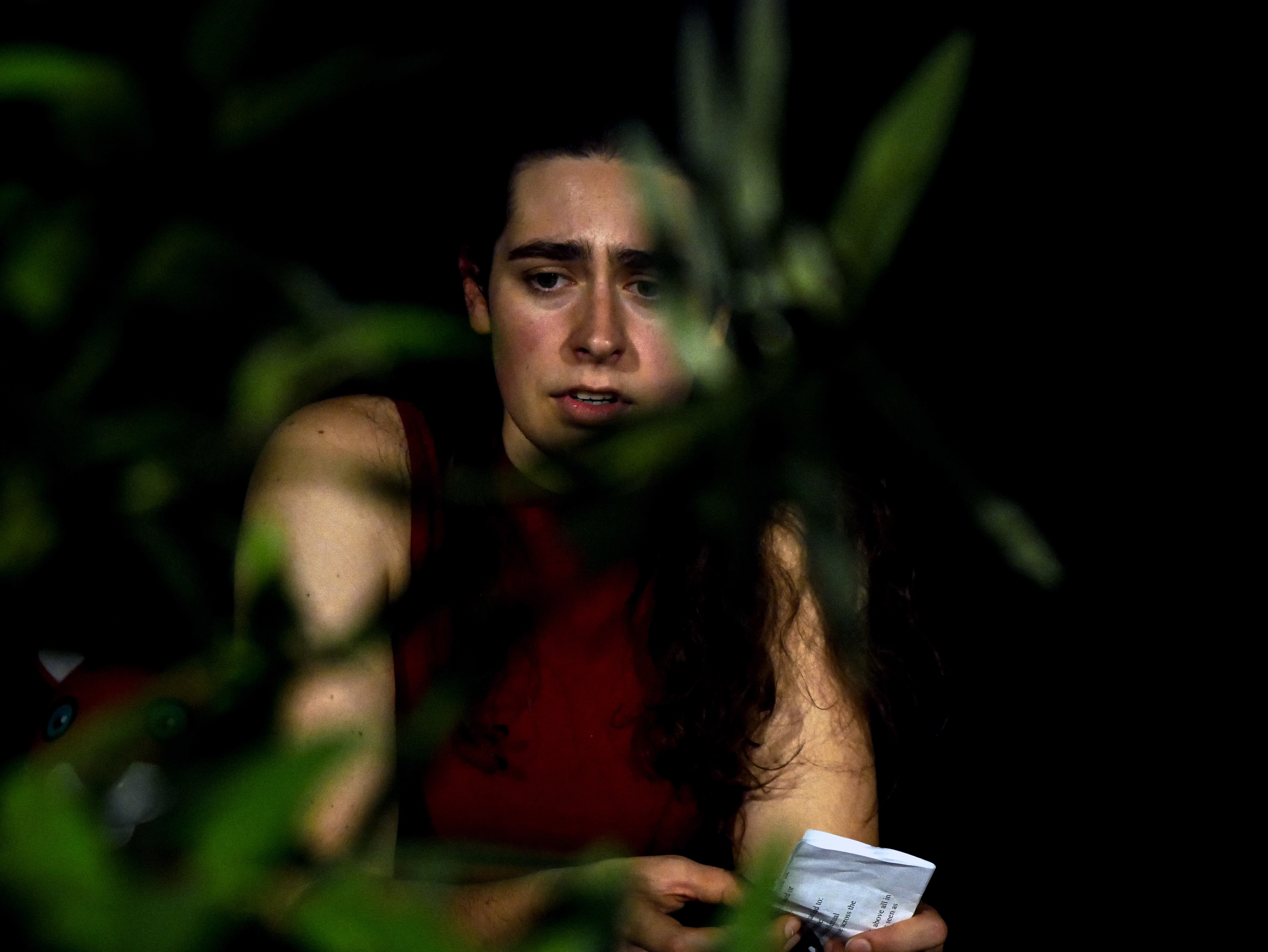
Lola displays her opposition to the impending death of her child by focusing on the importance of language, at one point seemingly trying to mandate the language of her partner. This easy, safe, middle-class method of revolt ultimately renders her impotent, showcasing the ineffectualness of postmodernism as an ideology of active resistance against the naked use of power and lies by fascist movements.
The play touches on different methods of resistance but also positions them as useless; evil happens when good men [sic] don’t stand up is not considered a viable option by Derrick and Lola. In this age, good people don’t stand up because they don’t want to lose their limited privilege; instead, they focus on trying to be better, or lament as Derrick does, why could we not be better? They aspire to be the hand that holds the whip even as they are metaphorically whipped themselves.
Derrick remarks in the play that these oppression cycles are part of human nature. However, this passive notion of inevitability is the vital ingredient in fascist regimes’ ascent to power and ignores the many historical instances when people have stood up and won, implying the counterfactual that there is no new future or that humanity cannot evolve. Therefore, the play offers no new hope and ignores the times humanity has moved forward in its collective projects.
Derrick also remarks on the shakedown of privilege as an inherent part of human nature. His story serves as a reflection of a culture that prioritises comfort over critical thought, where deep reflection is dismissed as overthinking, reinforcing simplistic narratives about human nature. In embracing this mindset, he effectively makes a Faustian pact with a ticking time bomb. This is exemplified by his role as a military enforcer for his fascist government.
For most of the play, the two characters remain separated on opposite halves of the stage, only coming together at the end to silence each other. This staging cleverly reflects how the left and progressives often focus more on battling their ideological neighbours than confronting larger systems of oppression, while those in power rally behind a dominant figure to maintain their privilege. However, while this blocking choice was conceptually striking, it felt jarring throughout much of the performance and as a result, it ultimately undermined the believability of the acting.
The most striking device in ARYAN is how it positions the audience as the disabled child, subtly casting us as the future generation – not yet the victims, but potentially next in line. This leaves us to consider how to break the cycle. Lola’s reflections on where society lost its way offer a clue, particularly her remarks on the echo chambers we’ve retreated into online. The play’s setting, confined entirely to Lola and Derrick’s lounge room, further reinforces the underlying message. To resist oppression, we must reconnect as a community, rather than ruling over our own digital fiefdoms or escaping into an artificial online world shaped by hyper-individualist, algorithm-driven narratives. And what better way to start than by experiencing theatre like this with family and friends?
C.J. O’HARTE
ARYAN by Amanda Crewes was presented at The Actors’ Hub Studios from 20 Feb – 21 Mar 2025.