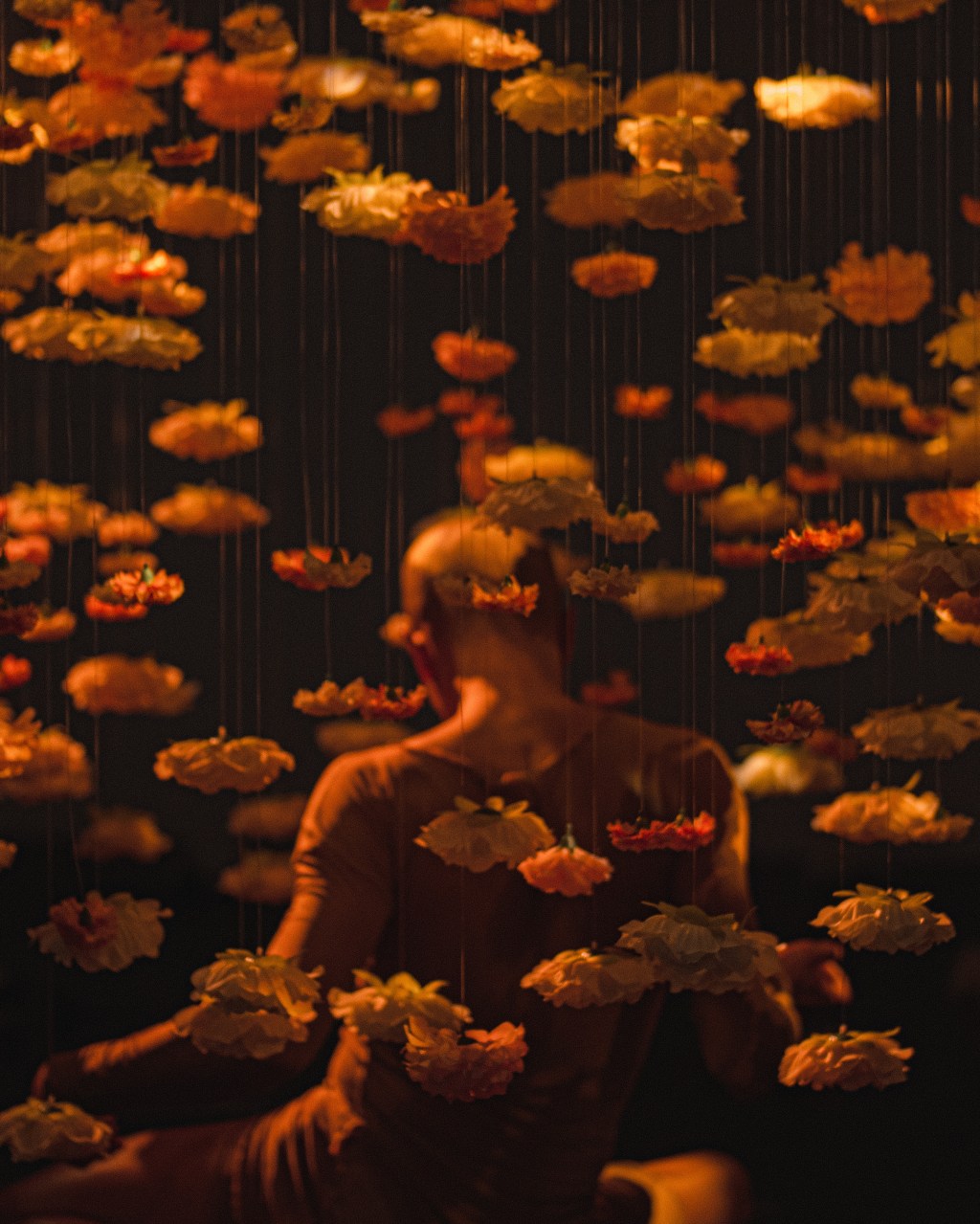
The media release for squared-OFF, a double bill of dance theatre presented by OFF-base Dance, describes the company’s artistic director Tyrone Earl Lraé Robinson as ‘visionary’. After attending the production on the Friday evening of its too-short, 5-night run, I can confidently say that calling Robinson ‘visionary’ is not marketing hyperbole. What’s more, any words I might use in this review to express my total and complete enjoyment of squared-OFF will also not be hyperbole. This was good. It was very, very good. So strap in readers, this could be a long one.
Robinson choreographed both 60-minute solo works, Madre Muerte and Acid Trip, with himself performing Madre Muerte and Boorloo dance theatre mainstay Bernadette Lewis performing Acid Trip. The two works couldn’t have been more different in tone, style, and aesthetics, but there was a commonality in their acute attention to detail, imagery, and narrative. The stagecraft was just as evocative, surprising, and judicious as any you’d see on the city’s main stages, if not more. Set inside Fridays Studio, a converted warehouse photography studio, Madre Muerte was performed in the main room (equipped with a large cyclorama), while Acid Trip was housed in the smaller space next door (equipped with a wall of frosted windows). I’m not sure how much the two works were site-responsive, but the spaces seemed tailor-made for each piece’s narrative world.
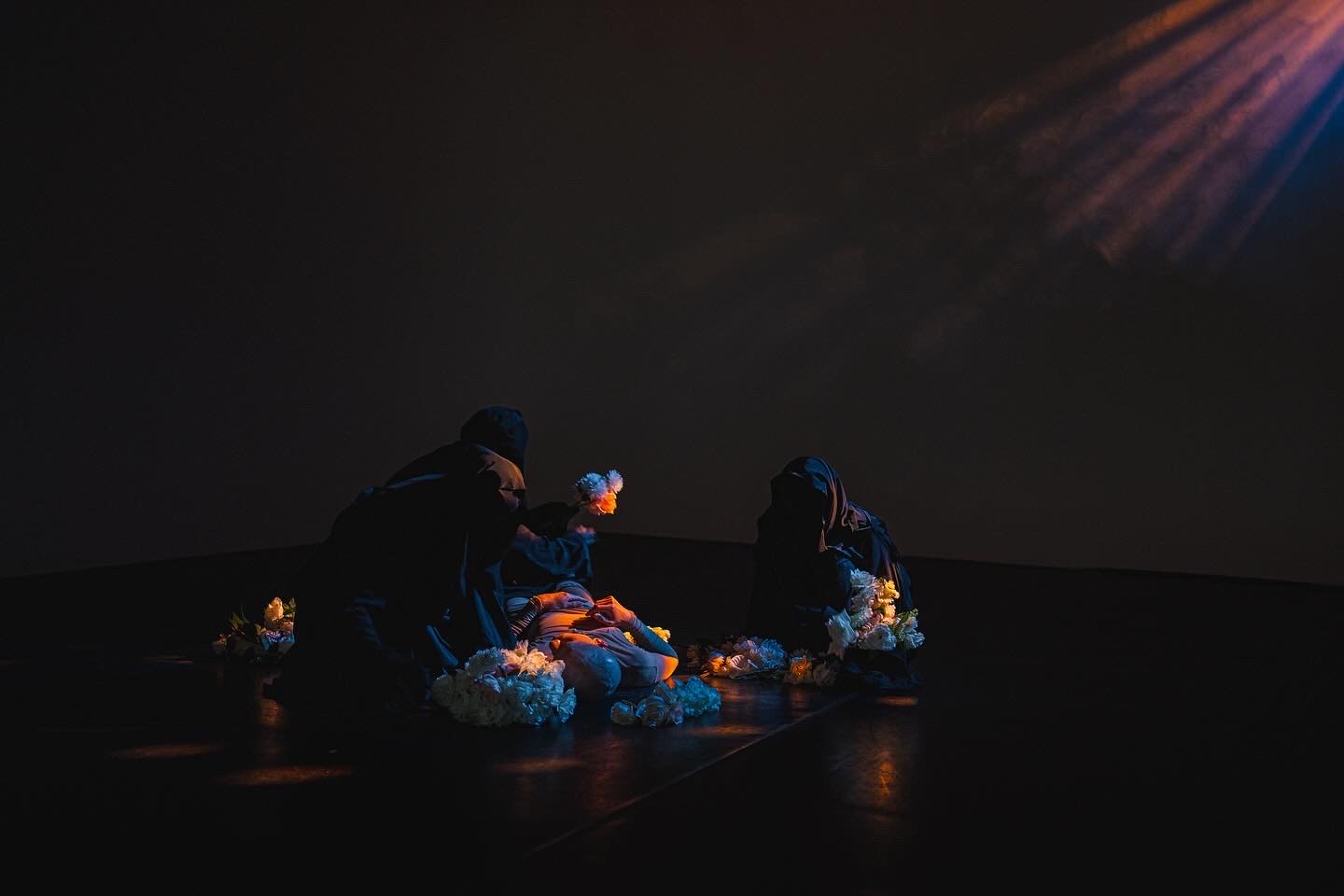
Before Madre Muerte began, three veiled ‘spirits’ (Ruby Hart, Mia Beame, and Rebecca Thomas) in head-to-toe ruched black shrouds (design by Sorcha Whalley and Leanne Foley), slowly wound their way through the gathering crowd. The effect was slightly unsettling, causing inattentional/perceptual blindness, and for me, my own personal jump-scare when I turned around and found myself suddenly facing one of them. Nothing like a good jolt to the heart to get the mind and body primed for a show about death.
Once inside the looooong performance space, the vast L-shaped seating had me stumped as to what would be the best vantage point, so I just went closest to where Robinson was positioned pre-show. I am glad to report that I chose wisely, as the bulk of the piece took place directly in front of me.
As previously mentioned, Robinson was positioned on stage from the start, though his figure and a bed of flowers laid before him were draped in a long black veil that slowly retracted, uncovering the flowers and then Robinson himself during what one could consider the piece’s prologue. This protracted moment allowed us the chance to settle into the sonic world of the work, a haunting music ritual composed by Rachael Dease.
Once Robinson emerged, we witnessed his transmogrification through various stages of life and death, vitality and collapse, vigor and stillness, grief and solemnity. He took on the posture of an old person, hunched and stooped, shuffling with stiff joints and faltering coordination. In my years of watching young people portray old folks on stage, I’d say Robinson’s corporeal transformation is the most thorough and accurate I’ve seen to date. When not embodying old age, Robinson is as graceful as a bird, as strong and agile as a warrior, and as otherworldly as a cryptid.
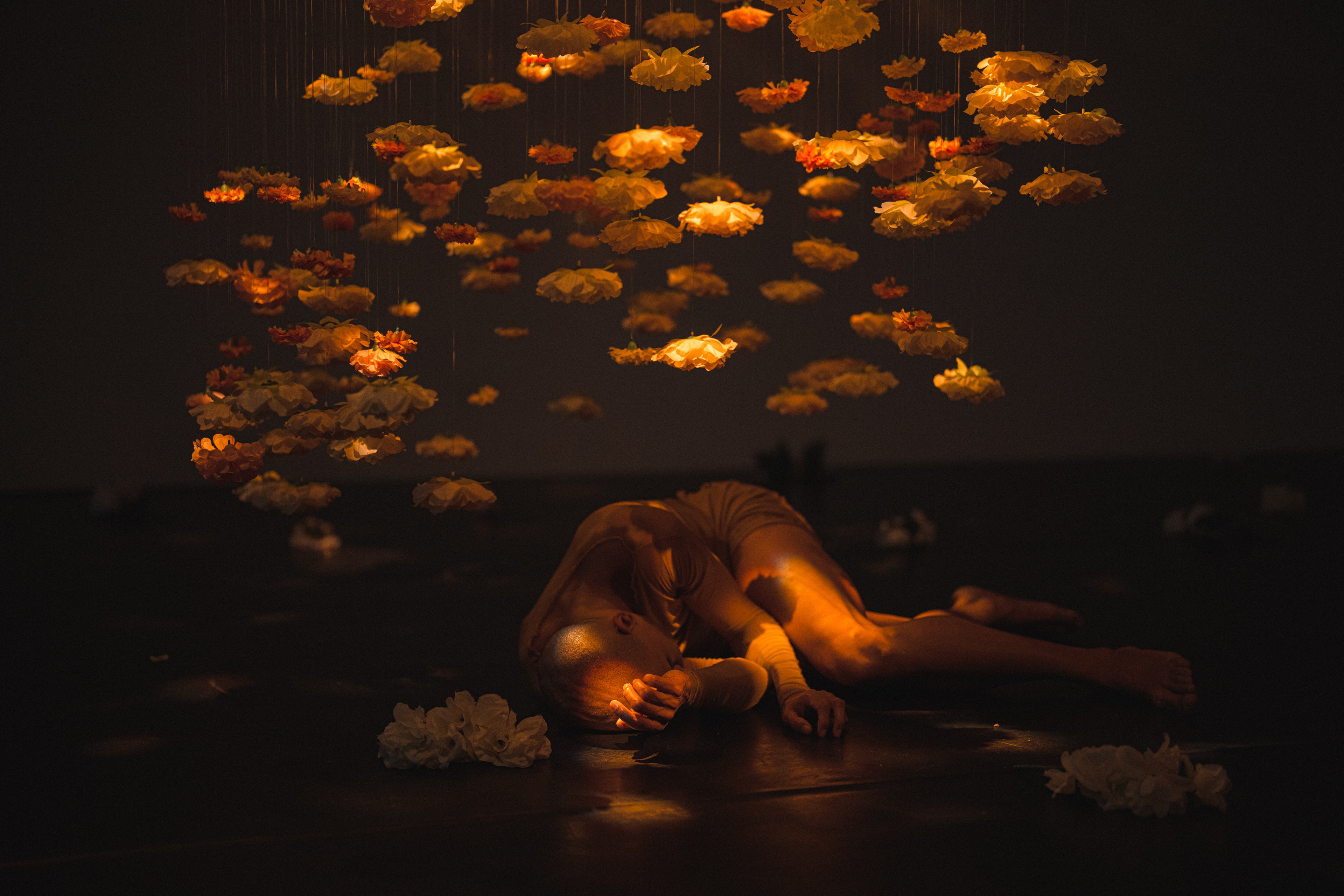
In one of the work’s prolonged movements or phases, Robinson gathers flowers from across the entire stage as the old person; initially, I balked at the thought of having to sit through this tedious process, but when I resigned myself to its unfolding, Robinson’s methodical commitment to each and every moment completely engrossed me.
It was an integral part of this ritual’s cycle in which flowers are the piece’s visual centrepiece and primary set design by producer Shuling Wong; at a critical stage in the show, flowers that had formed a ceiling over part of the stage began to descend, suspended from fishing wire, forming a chrysalis for Robinson’s eventual transformation. The flower motif served as a delicate counterpoint to the darker elements at play, like those three shrouded ‘spirits’, Robinson’s blanked-out pupils, the long black veil, the often mournful vocals from Dease. Rhiannon Petersen‘s lighting design heightened the drama and eerie atmosphere with shrewdly placed and focused spots, and warm sepia and amber washes lent a sense of reverence, fading memory, and gentle transitioning.
Madre Muerte gave me chills and thrills as a lover of gothic and folk horror, but it also gave me a space to meditate on the mystifying cycle of death, grief, mourning, regeneration, and renewal that humans (and other creatures) undergo. Fortunately, we had a healthy 30 minutes between it and Acid Trip to process and regroup. I needed it.
We moved into the next studio over, a more compact, square-ish space with a whitewashed, exposed brick rear wall, a bank of frosted-paned windows backlit in colour stage left, and a series of vertical LED light stands stage right. In the centre of the floor was a shaggy, swirly, two-tone rug and a pale pink pouffe, while in the upstage right corner sat a pale pink armoire.
The first movement of Acid Trip is set to the voiceover from Lockheed Martin’s anti-drug short film Case Study: LSD, which has ostensibly been given a good sound bath by Joe Paradise Lui. Lewis begins, not exactly reenacting this story, but certainly embodying in parallel the gradual descent into the chemically-induced state of madness that the film unintentionally parodies. As she slips, she starts to ‘climb the walls’, retreats into crawl spaces, and gets stuck in increasingly manic routines of movement. At one point she moves along the bank of windows, clinging to them for dear life, and I hold my breath as her body slides over the weathered metal frames and duct-taped shattered panes. She climbs through one of them and reemerges physically unscathed. Not so for her emotional and mental state.
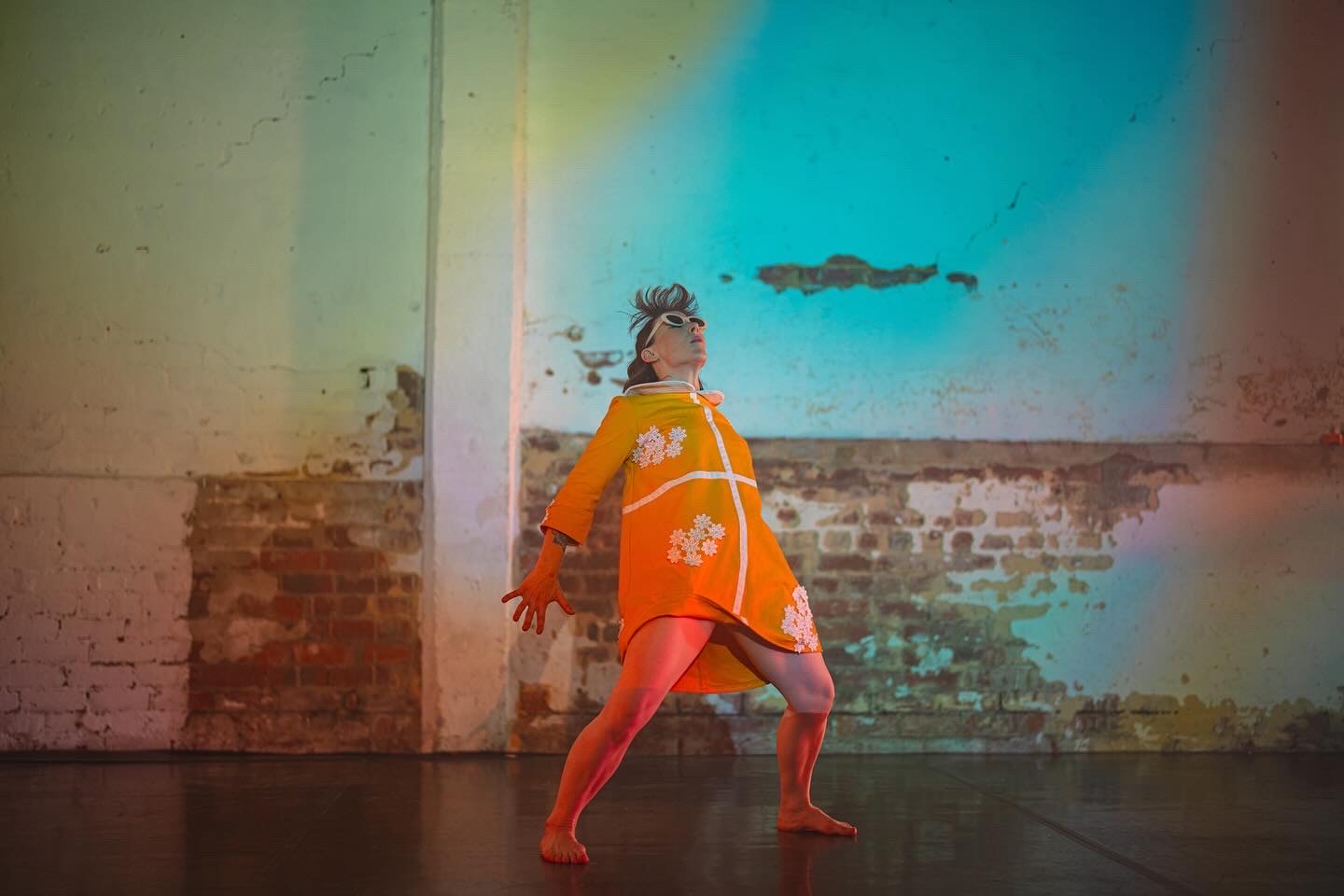
As the trip gets into full swing, Lewis’s hallucinatory world is heightened by the soundtrack (Lui), lights (Petersen), and audio-visuals (Mark Haslam) that allow us to join in the ‘experience’. Lewis disappears into the wardrobe and we are treated to a short film where we go from a frilly pink-ruffled mid-century bedroom into a mindscape of fractals, infinitely blooming flowers, and morphing colours and shapes that make you think that bits of missing plaster are actually faces emerging from the back wall. This went on a little long, but Lewis reemerges from the furniture in a whole new bright yellow a-line dress, designed by Eilish Campbell.
Lewis seems to be riding the wave confidently and vigorously, but gets caught in a loop that accelerates and becomes frantic. In the midst of this, a clever bit of AV tech allows a phone camera mounted discreetly downstage to feed a projection of Lewis’s live (but filtered) image onto the rear wall as a kind of window into her mental state. Eventually, she strips down to her underwear and the grindy, grueling end of the trip draws her back to the wardrobe. A spray of water shoots from the cupboard, dousing her back-lit form, giving us an inverse Flashdance moment as she cowers from the water. She slowly covers herself with a pale ruffled nightie which has become as limp and waterlogged as Lewis is.
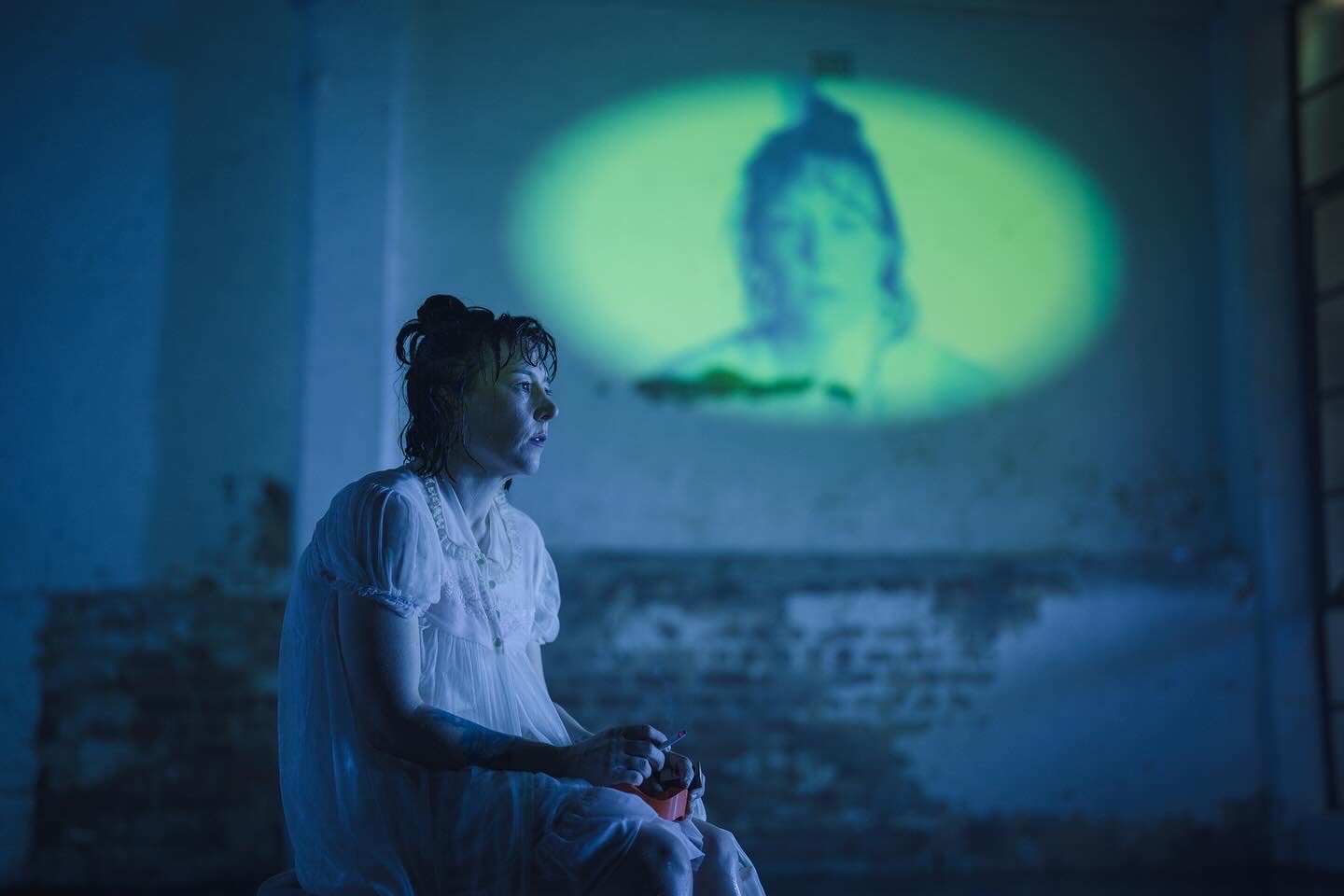
The piece’s finale sees her seated on the pouffe facing the camera, smoking a cigarette, while Tammy Wynette’s “I Don’t Wanna Play House” plays in full. Lewis has been through the wringer and it’s written all over her face and body.
Acid Trip is full of both light and dark humour, overt brightly-coloured fun, but also, exposed internal terror. Lewis’s full-bodied portrayal is better method acting than I’ve seen from any number of ‘trained’ actors, and an absolute delight to trip along with.
As the evening ended, the audience just didn’t want to move from their seats. They wanted more, and so did I.
CICELY BINFORD
squared-OFF, a double bill including Madre Muerte and Acid Trip, was presented by OFF-base Dance at Fridays Studio from 18 – 22 September 2024.