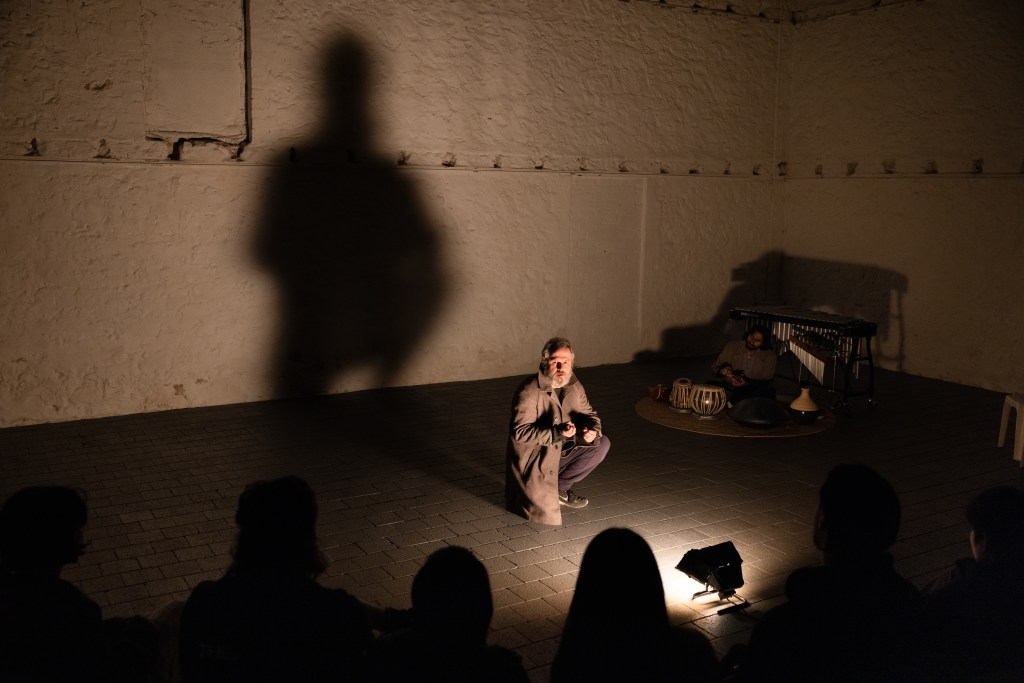
Taking a journey down to the Moores Building Art Space in Walyalup (Fremantle) took us on a journey to a village on the Black Sea with Humphrey Bower, in his adaptation of David Malouf‘s novel An Imaginary Life. Accompanying us on this journey with Bower is musician Pavan Kumar Hari in a site-responsive, unplugged, and intimate storytelling performance.
Bower is Ovid, the Roman poet most known for the Metamorphoses, who was exiled in AD 8 to Tomis (now known as Constanța, a Black Sea port city in Romania) for reasons that have remained largely unclear for centuries. Malouf’s story imagines Ovid’s life with a village elder’s family and chronicles his assimilation of the local languages and customs. While on a hunting excursion, Ovid spies a child in the woods, and when the hunting party discovers the child’s presence, they capture him and bring him back to the village. Ovid takes the child under his wing and teaches him to speak the local language, but as the family increasingly sees the child as a threat, Ovid realises he and the child must flee the village to find safety and peace in nature.
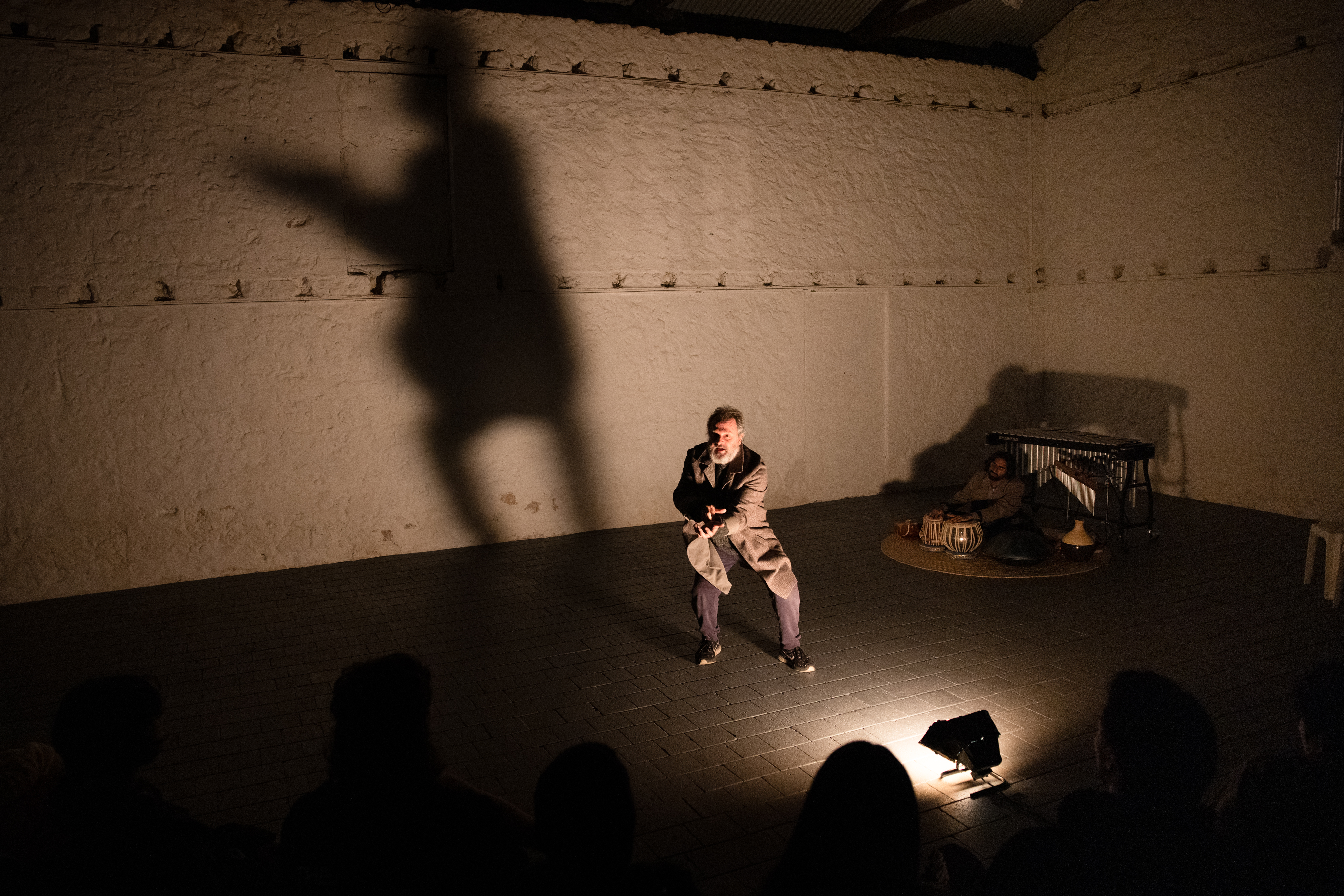
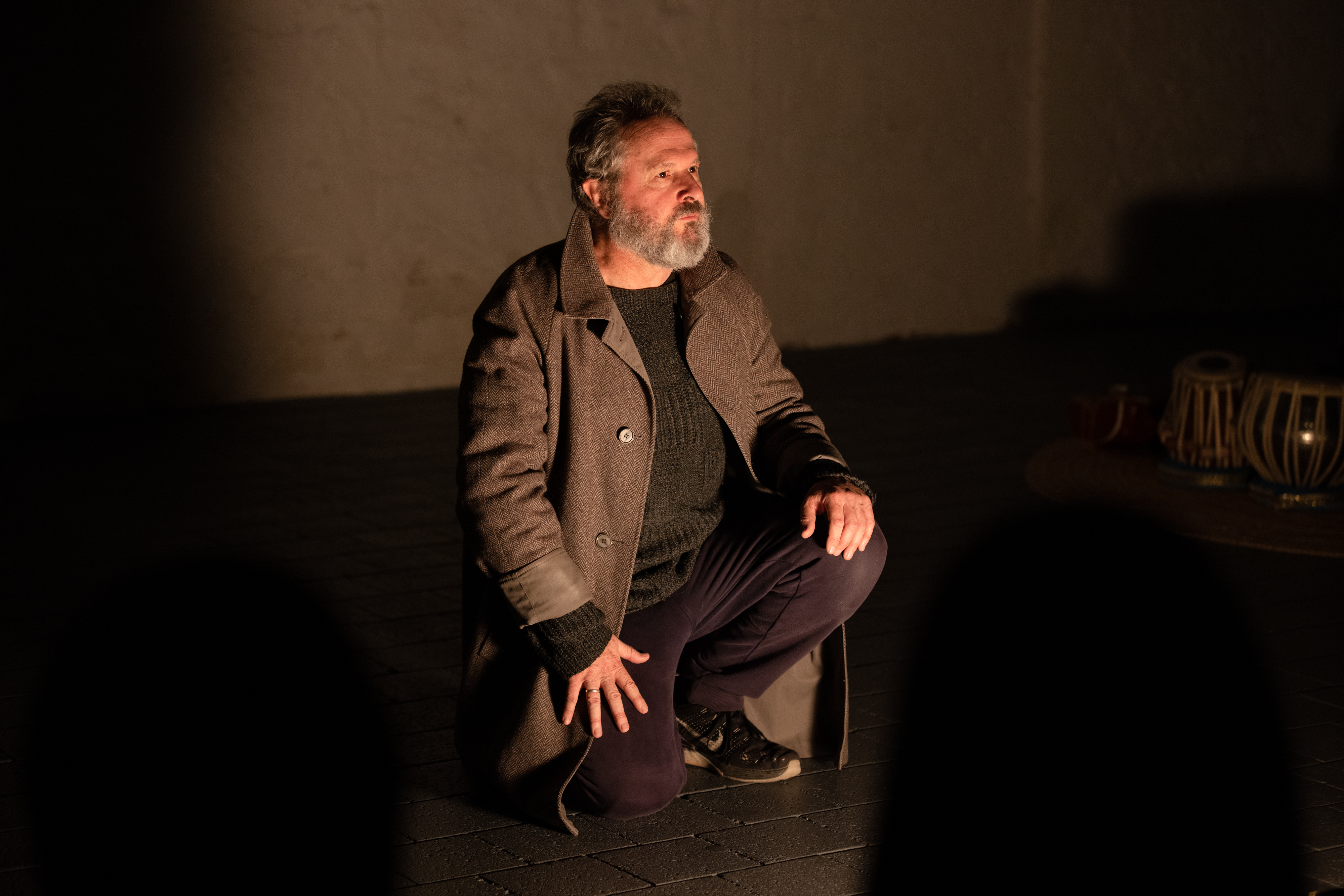
Whenever Humphrey Bower takes and/or is given the opportunity to present a (mostly) solo performance work, it’s as if a bell gets rung somewhere. My ears prick up, and I immediately check my calendar to make sure I won’t miss it. Bower is an innate wordsmith whose gift for language permeates every performance he gives; he embodies the written text and then alchemises it into tangible and specific thoughts, movements, and emotions. No gesture is vague or unmotivated, no pause is too protracted, and no breath is out of sync with the intrinsic rhythms of the dialogue. Bower sprints around the audience at two points in the narrative, each time physically encircling us with his excitement. He often glances over at Hari at key points, breaking Ovid’s fourth wall, but not the fourth wall between Bower and the audience. He crouches and prowls like an animal, and sits in quiet contemplation as his story rolls on.
As a site-responsive work, Bower and Hari make full use of the Moores Building’s surprisingly pleasant acoustics. The room’s vaulted ceilings, thickly coated white walls, and stone floors allow Bower’s voice to boom at full volume, but without distortion or disruptive echoing. It also allows quiet, delicate sounds to travel easily to our ears, and we enjoy rare moments of stillness in body and mind as Bower and Hari carefully hold us in their thrall.
Hari uses a range of percussive instruments to punctuate Bower’s actions and words. He uses a bow in inventive ways, like on a steel marimba or with a hand cymbal, to create acute, stretching tones to accentuate moments of tension in the action. His sound creations are directly responsive to the text in both an evocative and conversational function; it’s both atmosphere and dialogue.
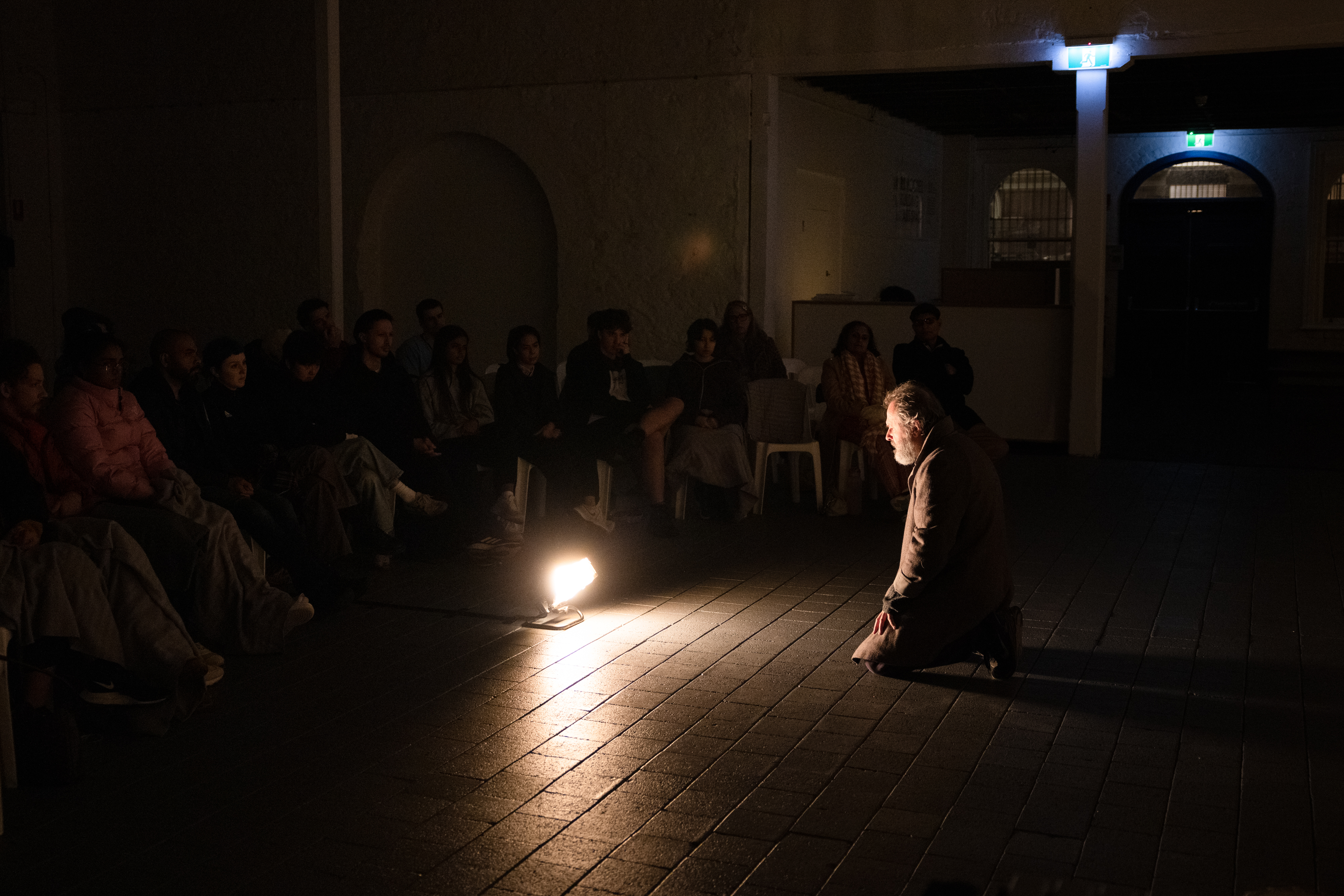
As for lighting, well, there’s not much to it – a simple single footlight was all that was needed to create the effect of campfire and hearth, casting Bower’s shadow on the vast white walls. This simplicity, this minimalism that Bower aims for in his performances, reminds us that human storytelling has existed around campfires and hearths long before Ovid put stylus to papyrus, and long before rotating stages, video projections, and intelligent lighting were even a glint in a producer’s eye.
CICELY BINFORD
An Imaginary Life was performed at the Moores Building Art Space in Walyalup (Fremantle) from 16 – 19 July 2024.